Soft Shell, Hard Chines
In the summer of 2025 we painted F2 ECO for the first time, in Nova Scotia (Uncharted Territory with F2 ECO), and in March 2026 for the second time, in Panama (How Hard Can It Be). Both times we ended by writing that the coming months would tell. Six months and 6,000 nautical miles have passed since that second coat. Panama, the Galápagos, the Marquesas, the Tuamotus, the Society Islands. Enough water under the keel for an interim verdict.
Let’s say it up front: we are not happy with F2 ECO. Then again, there is no perfect underwater coating, and by now we have seen enough boats with enough different problems not to pass judgement. So what follows is strengths and weaknesses. There are both — just not in equal parts.
What Came Out of Panama
Two points from the Panama post again, in short. Both show the same underlying issue: applying F2 ECO was complicated, and despite all the guidance from the distributor and the manufacturer, we were left guessing to the very end whether what we ended up with was a “good” coat of paint.
First, the coverage. The amount of adhesive coat that is supposed to cover 60 square meters, we spread over 48 — and it was very tight. That is 80 percent of the stated coverage, and even that only just. Anyone ordering F2 should calculate generously, because reordering on the move means three to four weeks of waiting.
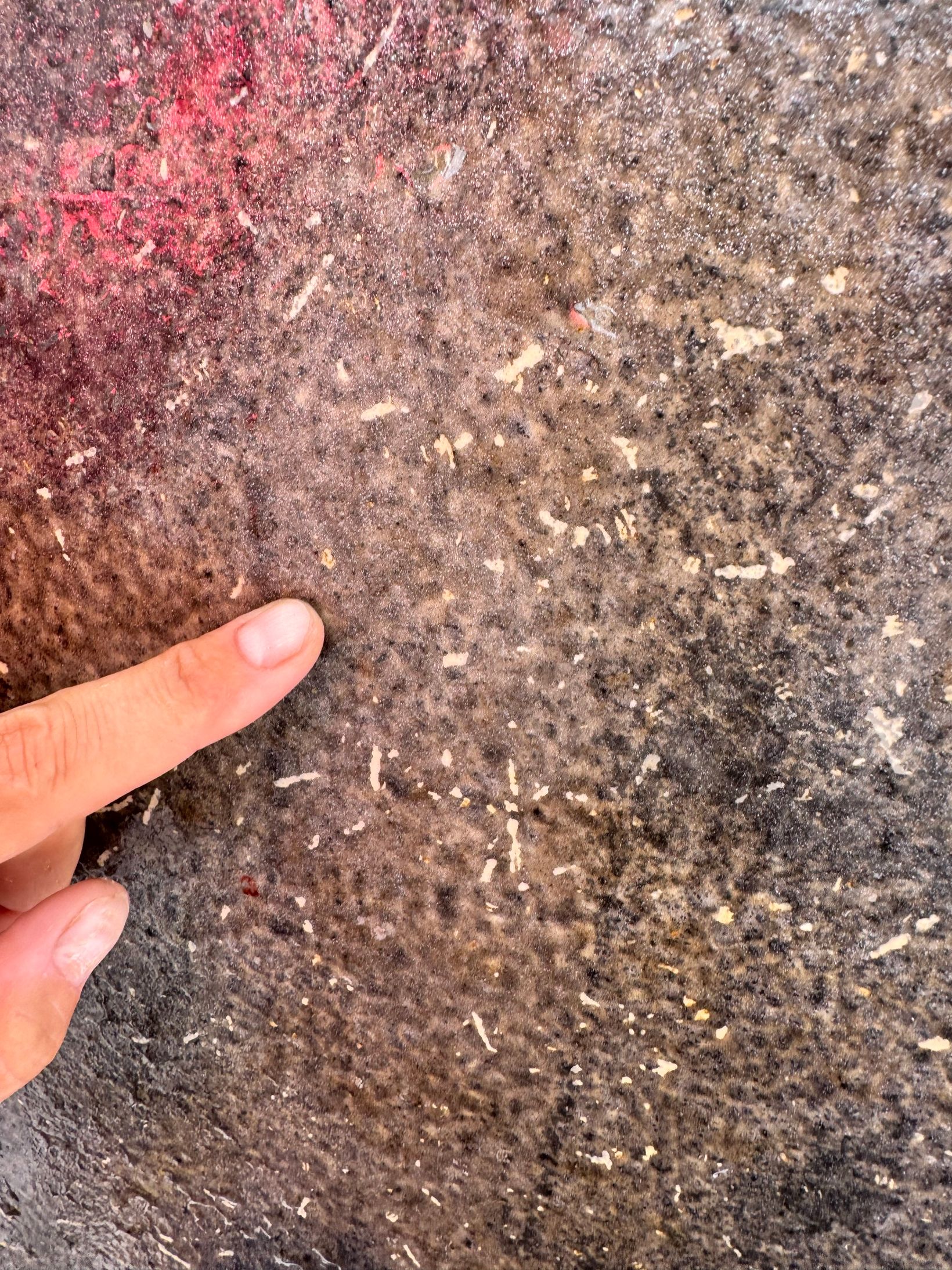
Second, the pigmentation. The adhesive coat is supposed to be black. Ours wasn’t, at least not in any way that covered. Over the beige F2 primer, the result was a look we call leopard print on a good day and crap brown on a bad one. According to the distributor, this doesn’t affect how well the coating works. So we assume the observations below are representative, and not just a report on a botched paint job.
Fouling
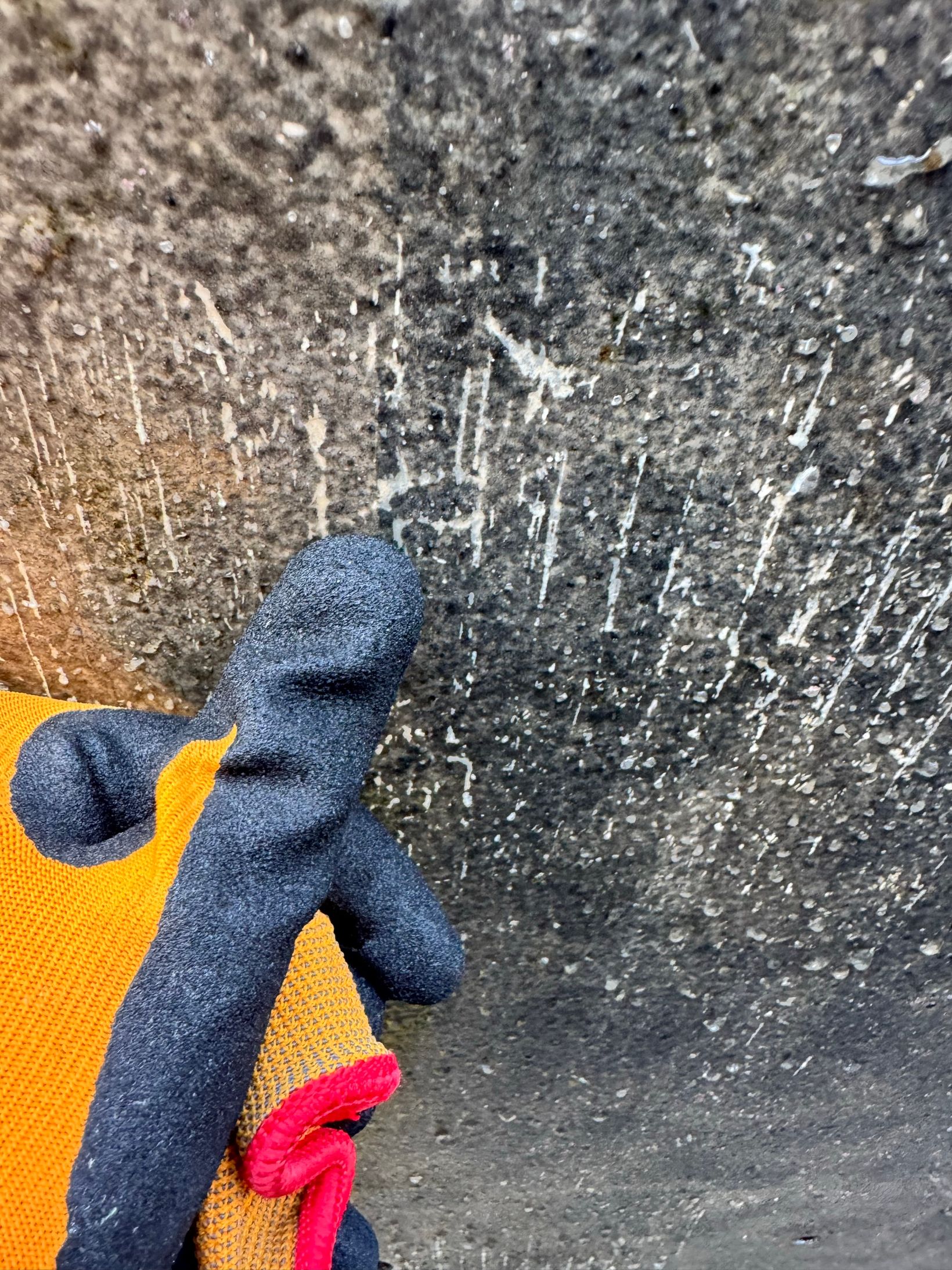
F2 ECO does not prevent fouling. That is neither a surprise nor a fault — it’s the principle. The manufacturer calls it a fouling release system, not an antifouling. Growth isn’t meant to be prevented, it’s meant to come off easily. And so a short, soft green growth forms on the hull, with the odd chalky deposit and barnacle finding a hold as well.
What’s true: the growth does come off fairly easily with a brush. Even barnacles can be pushed sideways off the coating with a finger — no scraper needed. That is a marked difference from our underwater garden back in the Caribbean.
What’s also true: easily is relative. A hull cleaning still takes us an hour and a half with a brush and no scuba tank. At least the work happens in turquoise water at 27 degrees. It’s still work.
The rhythm in the tropical water of French Polynesia is fairly predictable. Two weeks after a thorough cleaning, the first patches of growth are clearly visible; after two months at the latest it is reasonably dense. The longer, heavier growth that dramatically kills your speed never takes hold — we have seen those extreme cases on boats with other coatings that crossed the Pacific alongside us. But the dense short growth isn’t nothing either. After two months you can safely reckon on half a knot less boat speed. So a cleaning round before longer multi-day passages is worth it, and more often than that if you care about your sailing performance.
This is where the marketing and the reality part ways. We chose a product where a light brushing every few months was supposed to be enough. In tropical water, that has turned into an hour and a half of work every four to eight weeks.
Durability: The Real Disappointment
When we decided on F2 ECO, the distributor was still advertising it as a hard-wearing coating. That mattered to us, because Nikola is designed, among other things, to take the ground and sit on her own hull in tidal waters.
In practice, the coating is quite soft.
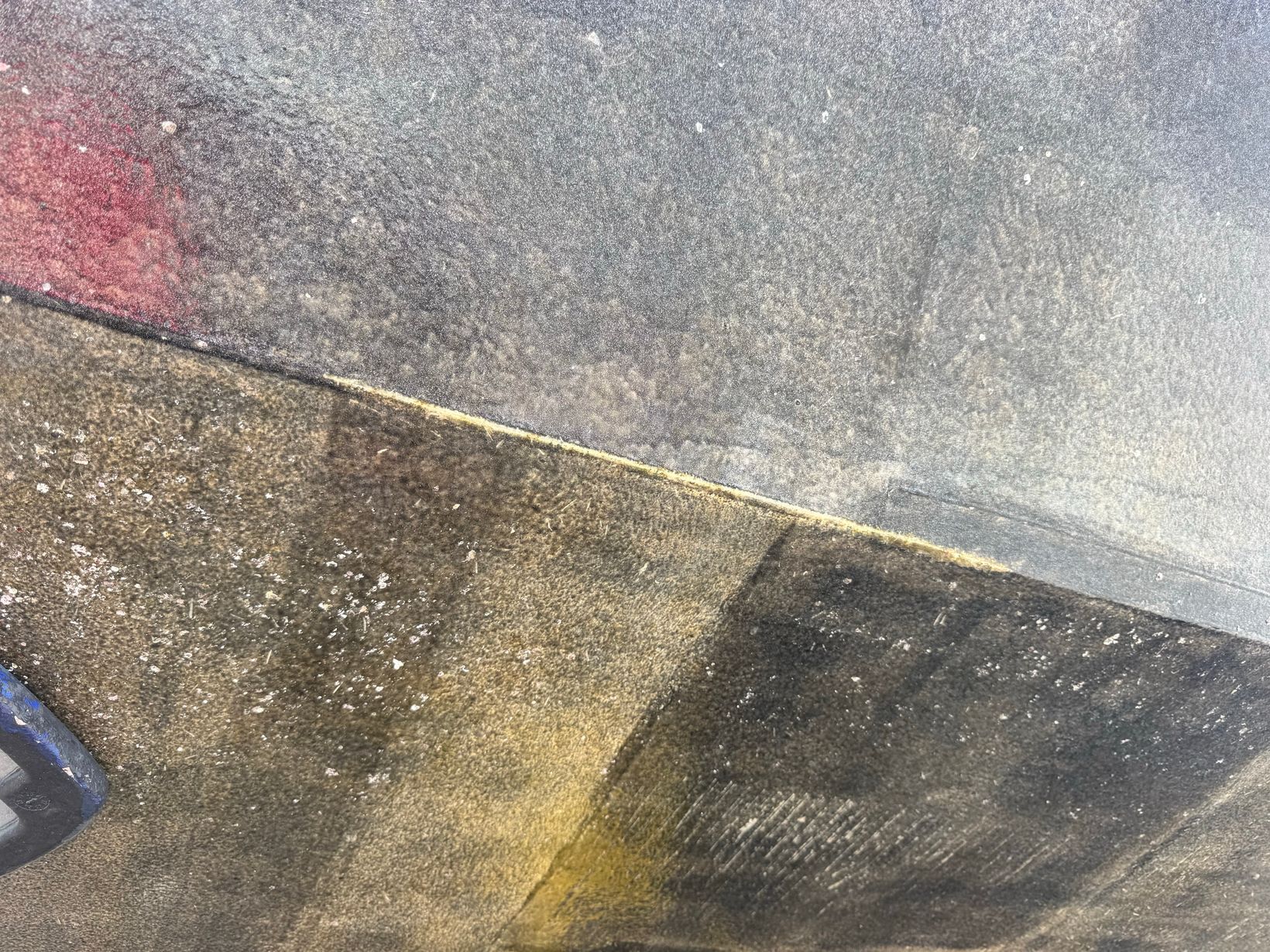
So far, every single haul-out and launch has left minor damage, with a sling travel lift just as much as with a trailer lift. Every time, we have had to arrange the best possible padding ourselves, which makes craning at unfamiliar yards in foreign countries — always an exciting moment anyway — that much more complicated. Our chined hull makes it worse: under the slings, very high loads build up at the chines in a very small area.
Away from the slings, care is needed too. While cleaning with a brush, one slip is enough for a fingernail to leave a scratch that takes off both top coat and adhesive coat.
On the flat underside of the stern, on top of that, irregular damage has appeared in both top coat and adhesive coat with no mechanical explanation. No sling has sat there, and no brush either. We suspect a particular angle of flow, wave slap, or prop wash — but we don’t know.
It goes without saying that we would not dry out on this coating as things stand. That is a genuine shame, because before we had F2 ECO we enjoyed it a lot, and it was one of the reasons we chose this boat.
Given the various small areas of damage after only six months, we assume the manufacturer’s stated durability of “5+ years” is only achievable for us with serious caveats, and that a lunar landscape of craters is slowly forming. Whether repairs can be done effectively we don’t know — especially where both adhesive coat and top coat are affected.
What Is Genuinely Good
For all the criticism, two things clearly count in F2 ECO’s favour.
Cleaning the hull is possible at any time, anywhere, with the simplest of means. A day before arriving in the Galápagos, where the rules on underwater growth are very strict, we cleaned the hull in the open ocean. Brush, mask, done. And you expose yourself to no toxic residue while doing it. Anyone who has ever scraped antifouling off a hull and watched the cloud drift past them knows what that is worth.
And the short, soft green growth still allows normal passages with little braking effect. In the Marquesas we watched boats arrive from Panama suffering under heavy fouling, their passages stretching beyond 40 and in some cases beyond 50 days. That, we were spared.
Interim Verdict After 4,000 + 6,000 Nautical Miles with F2 ECO
On balance, we are not happy with F2 ECO. That has less to do with what grows on the hull than with what happens to the hull the moment anything touches it.
F2 ECO is not an antifouling but a fouling release system — the manufacturer describes it that way too. Growth isn’t prevented, it’s made easy to remove. That is the product’s strength, and that part works for us.
The deal is: regular brushing in exchange for no biocides.
Reckon on a cleaning every four to eight weeks in tropical water, depending on your standards, and on one to one and a half hours per round without a tank. The advertised “light brushing every few months” is not what we experienced.
Before multi-day passages, a round is worth it. Half a knot is half a knot.
Coverage came out at roughly 80 percent of the manufacturer’s figure for us. Order generously.
The coating is mechanically delicate. For a heavy chined hull that gets craned regularly, we still consider it unsuitable — that was already our conclusion in Canada and nothing has changed.
Drying out on this coating is, in our view, off the table.
“5+ years” strikes us as optimistic after six months. And not only because of the craning damage: the coating has also worn away on the underside of the stern in the water, with no mechanical explanation for it.
And the usual caveat: this is one hull, one coating, one cruising ground. Solid comparative data on underwater coatings is rare, which is exactly why we are writing this down.
Where We Go From Here
We have made our peace with the brushing. With the crater landscape we haven’t. What that means for the next coat, we don’t yet know. Do we stay with it and touch up the damage, assuming that can be done sensibly at all? Or go back to a conventional system that can be bought anywhere and survives a haul-out, but works with biocides and has to be renewed regularly? Both come at a price. When we have decided, we’ll write about it.